
Russia’s state-linked paramilitary structure — the Wagner Group, now largely absorbed into the Ministry of Defense-run “Africa Corps” — has spent nearly a decade exploiting the Central African Republic’s (CAR) gold, diamonds, timber, and smuggling networks in exchange for regime protection.1 This article’s core thesis remains unchanged from the original assessment: Africa Corps is a form of geocriminality — the state’s instrumentalization of criminal markets abroad for strategic gain, fusing state sponsorship with opportunistic criminal enterprise. What this rewrite adds is a structural lens on why CAR has proven such fertile ground for that model, using the Moral Disorder Index (MDI) framework, and a sharper answer to what the United States should actually do — not only to blunt Russian influence, but to make CAR a viable, investable partner in its own right.
Wagner’s Political Economy, Briefly
Wagner became operational in CAR in 2017 under a formal mandate of roughly 175 military trainers; by 2021 it was fighting alongside government forces, with troop levels reaching around 1,500 personnel by early 2026.1 Rebranded in 2023 following Yevgeny Prigozhin’s death, the group now operates under Russia’s Ministry of Defense and GRU. OFAC designated Wagner a transnational criminal organization on January 26, 2023, sanctioning affiliated firms for illicit mining, illegal trade, and human rights abuses.2
Wagner’s durability rests on what Christopher Spearin calls “concessionary politics”: resource extraction financing payoffs to President Faustin-Archange Touadéra and the ruling elite while the state itself remains deliberately underdeveloped.5 In exchange for security and political protection — most recently, help delivering Touadéra’s disputed third-term election in December 2025 with 76–78% of the vote after removal of constitutional term limits9,1 — Wagner embedded itself across CAR’s military, intelligence, and economic structures, controlling assets like the Ndassima gold mine and laundering proceeds through UAE-linked structures and shell firms such as Midas Resources, Meroe Gold, Lobaye Invest, and Diamville.3,6,4 Proxy militias — the “Black Russians,” the “Sharks,” and Azandé Ani Kpi Gbé (AAKG) — extend Wagner’s reach through bribery, extortion, and violence.
Measuring the Damage: CAR Through the Moral Disorder Index
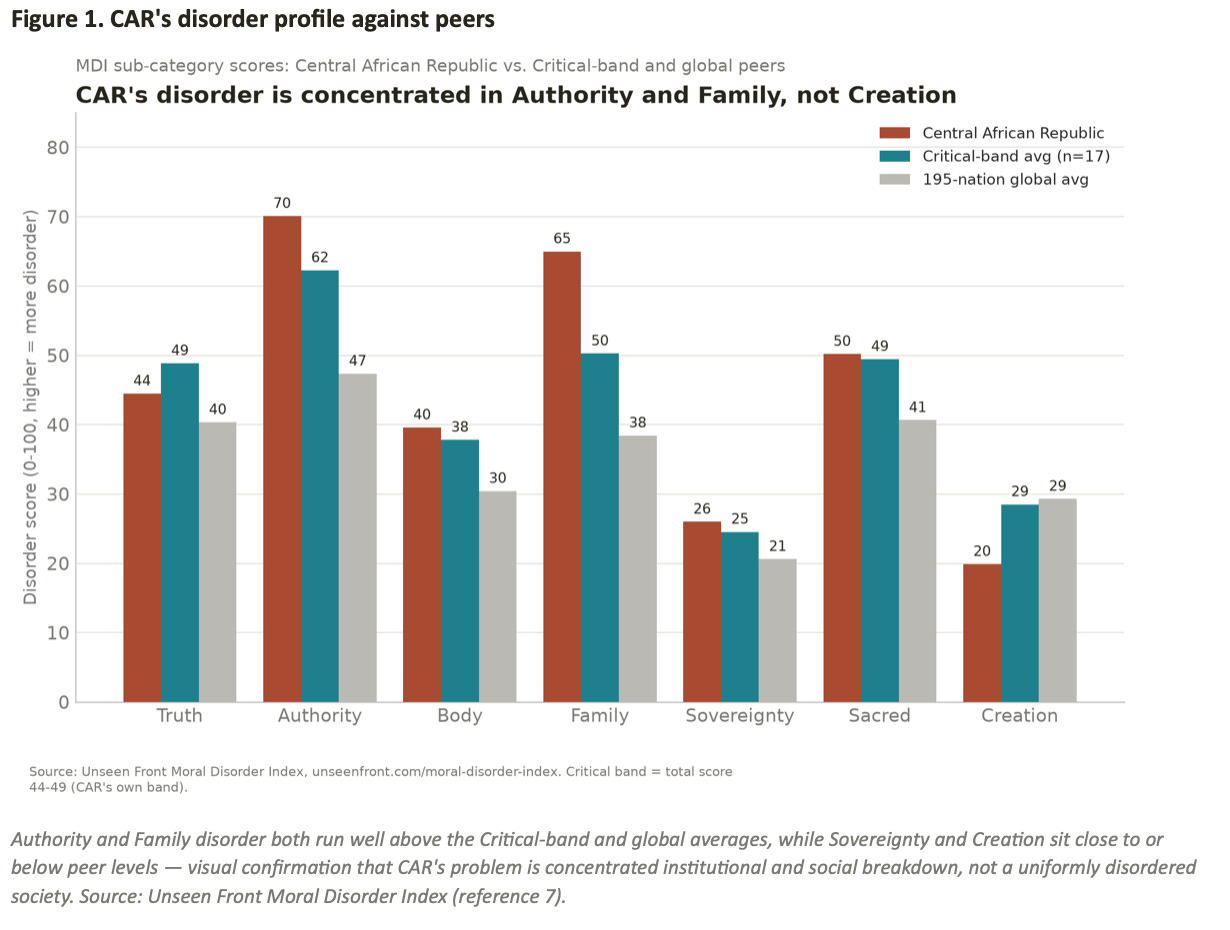
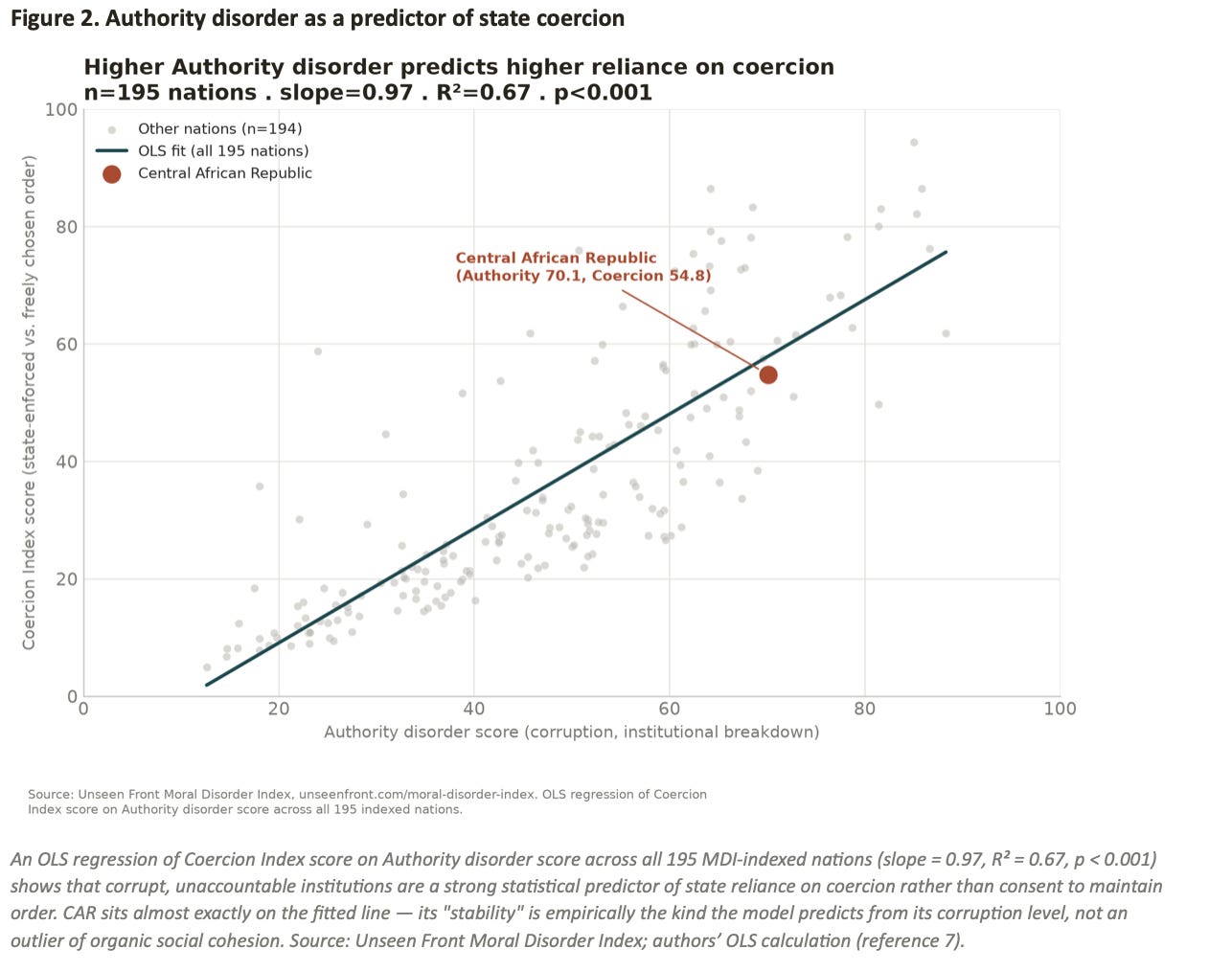
The Wagner Group thesis describes a mechanism. The Moral Disorder Index describes the structural terrain that made the mechanism so effective. CAR currently ranks 7th out of 195 nations on the MDI, with an overall score of 49.3 — placing it in the “Critical” band, one step below the worst-performing tier globally.7 The country also carries a Coercion flag, meaning a meaningful share of its apparent order is enforced compliance rather than freely chosen social stability.
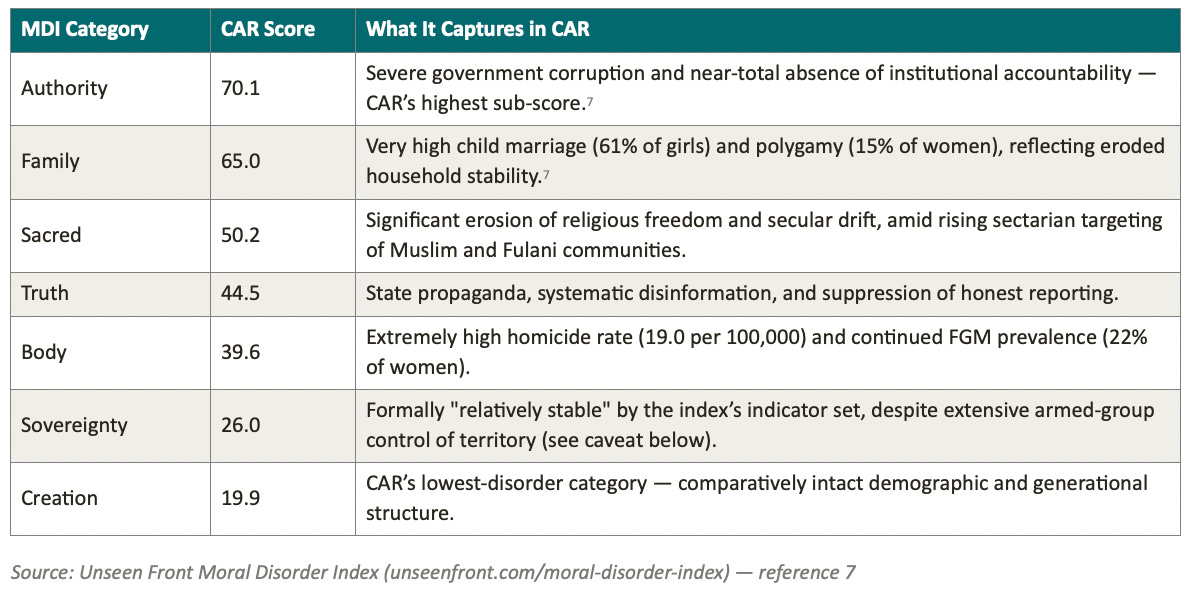
Three observations from this profile matter directly for policy design.
First, Authority disorder is the dominant driver of CAR’s score, and it is the same disorder Wagner monetizes. A score of 70.1 — CAR’s highest sub-score by a wide margin — is the quantitative signature of exactly the “concessionary politics” the original thesis describes: an elite that treats public office and resource concessions as instruments of personal enrichment. This means that policy aimed only at removing Wagner’s boots on the ground, without addressing the underlying corruption architecture, will simply create a vacuum for the next external patron.
Second, CAR’s Truth disorder (44.5) is not incidental — it is Wagner’s information-operations infrastructure showing up in the data. Russia has financed newspapers, billboards, films, and social media networks in CAR to discredit domestic opposition and Western actors while glorifying the regime.5 The MDI’s Truth score is, in effect, a partial measurement of how successful that campaign has been at corrupting CAR’s information environment.
Third, and most important for both US policymakers and investors: CAR’s Coercion flag means its overall stability should be read with real caution. The MDI’s Coercion Index exists precisely to distinguish genuine social order from order manufactured through fear and state enforcement. CAR’s Coercion Score of 54.8 (”Elevated — significant state enforcement shapes moral behavior”) signals that whatever surface stability accompanied Touadéra’s third-term consolidation — a boycotted opposition, a disputed election Russian officials publicly took credit for helping secure, and a security apparatus built on foreign mercenaries — is not the same thing as durable institutional legitimacy.8,9 This is the analytical bridge between the MDI and the Wagner thesis: Africa Corps does not merely exploit CAR’s disorder — it actively manufactures a coerced substitute for order, which is precisely why its removal without institutional reform risks immediate relapse rather than genuine stabilization.
A caveat worth flagging honestly: CAR’s Sovereignty sub-score (26.0) reads as comparatively low-disorder relative to the country’s other categories, which may understate the operational reality on the ground. Fighting between government forces and the Wagner-trained-then-defected AAKG militia intensified in Haut-Mbomou prefecture immediately after the December 2025 election, disrupting voting, and cross-border dynamics with South Sudan and Sudan continue to strain state control in the southeast.10 The gap between the index’s formal sovereignty indicators and the lived security environment is itself a useful signal: it illustrates why any single index — including the MDI — should be read alongside conflict and security reporting, not as a substitute for it.
The 2026 Inflection Point
Several developments now underway make CAR a live test case rather than a static problem:
Moscow is trying to force a costly transition. Russia is pressing Bangui to replace the self-funded Wagner model with the Ministry of Defense-run Africa Corps, which demands direct cash payment for security services CAR cannot easily afford — a demand Touadéra has so far resisted, preferring to pay in mineral concessions.11,12
Wagner’s proxy militias are turning on the state that hosted them. The AAKG’s 2026 insurgency in the southeast is a textbook case of “proxy blowback” — a Russian-armed local force that lost command discipline over unpaid wages and is now destabilizing the very regime Wagner was hired to protect.10
France and the UN are re-engaging, but funding is thin. Paris resumed budgetary support (€35 million between late 2024 and late 2025) in exchange for reduced anti-France disinformation, while the UN’s MINUSCA mission is more than 60% underfunded — $733 million of its $1.17 billion annual budget unpaid as of February 2026.9,13
The UN Security Council is set to renew CAR sanctions through July 2027, maintaining the arms embargo on armed groups and the Panel of Experts monitoring illicit resource flows.14
Policy Recommendations
The original article’s three policy directions remain sound and should anchor US strategy — with two structural additions informed by the MDI’s Authority and Truth findings.
1. Tie all assistance to verifiable anti-corruption benchmarks. Rather than delivering aid unconditionally to the presidency, US and multilateral support should be conditioned on transparent mining licensing, an independent oversight mechanism for extractive resources, and published budgets. This directly targets the Authority disorder (70.1) that is CAR’s dominant structural weakness and the mechanism through which Wagner buys elite loyalty.
2. Invest in independent local media and counter-disinformation literacy. Contesting the domestic information space that Wagner-funded outlets currently dominate is the most direct way to lower CAR’s Truth disorder score and reduce Moscow’s ability to shape domestic political narratives ahead of future elections.
3. Coordinate US, UK, and African Union enforcement against sanctions-evasion networks — including downstream buyers, not just individuals. Wagner-linked companies (Midas Resources, Meroe Gold, Lobaye Invest, Diamville) rebrand and evade embargoes; fragmented enforcement lets them succeed. Policy should target refiners, transit hubs, and offshore buyers — with particular attention to UAE-based intermediaries — closing the pathways that convert CAR’s resources into hard currency for Moscow.4,5
4. Underwrite CAR’s EITI corrective-action plan and mining cadastre, rather than treating transparency reform as a side issue. CAR’s 2024 Mining Code requires beneficial-ownership disclosure and EITI/Kimberley Process compliance, but the country was suspended from EITI in November 2024 after scoring “low” (39/100) on transparency, with the Board explicitly flagging concerns about mining rights awarded to companies affiliated with the government’s paramilitary security contractors in exchange for services.15 US technical and financial support for the beneficial-ownership registry and licensing cadastre — administered through GEMINCA, the state monitoring body — would simultaneously de-risk the sector for legitimate investors and expose the Wagner-linked concession structure to public scrutiny.
5. Help close CAR’s security-financing gap so Bangui has an alternative to paying Moscow in minerals. With MINUSCA underfunded by over 60% and Russia demanding direct cash payment for Africa Corps deployment that Touadéra cannot afford, the US and partners have genuine leverage. Backing MINUSCA’s budget, supporting demobilization of AAKG and other Wagner-origin militias, and offering conditioned security-sector-reform assistance gives Bangui a credible off-ramp from a financing arrangement it may not even want to keep.
What International Development Investors Need to Know About CAR
CAR’s MDI profile and its investment climate are two views of the same underlying reality — investors weighing entry should read both together.
Political risk is elevated and coercion-linked. Touadéra secured a third term in December 2025 after removing constitutional term limits, with the opposition boycotting and Russian officials publicly claiming credit for the security conditions that made the vote possible.16,9 The MDI’s Coercion flag on CAR is a direct warning that current political stability is manufactured rather than institutional, and could prove brittle if security-force loyalties shift — as they already have with AAKG.
Legal and regulatory transparency is improving on paper, weak in practice. The 2024 Mining Code requires EITI and Kimberley Process compliance and beneficial-ownership disclosure, but CAR remains under an EITI corrective-action plan after its November 2024 suspension, and government agencies lack the IT systems to produce reliable production and export data.17,18 Investors should expect a multi-year gap between the law on the books and enforceable transparency.
Sanctions exposure is a live counterparty risk, not a theoretical one. Any investor entering CAR’s mining, timber, or logistics sectors must conduct enhanced due diligence to avoid co-mingled supply chains touching OFAC-designated Wagner-linked firms (Midas Resources, Meroe Gold, Lobaye Invest, Diamville) or their successor entities. Sanctions evasion runs through shell structures and UAE-based intermediaries, so second- and third-tier counterparty screening matters as much as direct relationships.2,3
Geography determines risk-adjusted opportunity. The World Bank identifies high-grade gold deposits in the relatively stable, better-connected western part of the country as the most viable near-term entry point, given gold’s high value-to-infrastructure ratio.19 By contrast, the southeast — particularly Haut-Mbomou — is actively contested by the AAKG insurgency and should be treated as a no-go zone for the foreseeable future.10
Macro fundamentals are modest but improving. Real GDP growth is forecast at 2.1% (2025), 2.2% (2026), and 2.8% (2027), driven by agro-processing and services, contingent on energy access and continued donor concessional funding.19 A July 2026 World Bank report calls for urgent public-finance reforms — domestic revenue mobilization, debt management, procurement transparency, and donor-coordination — as preconditions for translating resource wealth into broader growth.20
There is a viable US-backed model to adapt. The US-DRC Strategic Partnership Agreement — pairing Development Finance Corporation (DFC) capital with a critical-minerals framework, preferential access for vetted US companies, and government transparency commitments — offers a template Washington could scale down for CAR’s gold sector, using conditioned DFC financing to reward exactly the transparency and anti-corruption reforms recommended above.21,22
The Strategic Convergence
The central insight the MDI adds to the original Wagner thesis is that countering Russian influence and improving CAR’s investment climate are not two separate US objectives competing for resources — they are the same project. Wagner’s leverage in CAR is built almost entirely on exploiting CAR’s Authority disorder (corruption) and Truth disorder (disinformation). Every dollar of US assistance that strengthens transparent licensing, independent media, and enforceable beneficial-ownership rules simultaneously weakens the mechanism Wagner depends on and lowers the risk premium legitimate investors currently price into any CAR opportunity. Conversely, a purely security-focused counter-Wagner strategy that ignores the underlying Authority and Truth disorders — treating CAR’s stability as a problem of troop numbers rather than institutions — will simply reproduce the conditions for the next external patron, whether Russian, or otherwise, to exploit.
Sources
1. Congressional Research Service. (2026, April 8). Russia’s Security Operations in Africa. everycrsreport.com
2. U.S. Department of the Treasury. (2024, May 29). Treasury Sanctions Wagner Group-Linked Companies in the Central African Republic [Press release]. home.treasury.gov
3. Dukhan, N., & De Koning, R. (2026, June). Malicious Markets: Mapping the Violent Criminal Ecosystem in the Central African Republic. Global Initiative Against Transnational Organized Crime. globalinitiative.net
4. Stanyard, J. (2025). Mercenaries and Illicit Markets: Russia’s Africa Corps and the Business of Conflict. Global Initiative Against Transnational Organized Crime. globalinitiative.net
5. Spearin, C. (2024). Russia’s Wagner Group/Africa Corps: An Authoritarian Conflict Management Examination. Conflict, Security & Development, 24(5), 479–499. doi.org/10.1080/14678802.2024.2415659
6. Carraway, L. W. Jr. (2025). Strategic Disruption: Opportunities to Counter Russian Paramilitary Expeditions within Sub-Saharan Africa. Journal on Baltic Security, 11(1), 28–57. doi.org/10.57767/jobs_2025_005
7. Unseen Front. Moral Disorder Index. unseenfront.com/moral-disorder-index
8. Unseen Front. Guide to the Moral Disorder Index. unseenfront.com/guide
9. Le Monde. (2026, March 14). France Returns to the Central African Republic After a Period of Cooling Off. lemonde.fr
10. Robert Lansing Institute. (2026, January 12). Wagner’s Blowback in the Central African Republic. lansinginstitute.org
11. Africa Intelligence. (2026, May 15). Touadéra Due in Moscow Amid Tensions Over Wagner and Africa Corps. africaintelligence.com
12. PBS. Russia Asks Central African Republic to Replace Wagner With Moscow’s Africa Corps. pbs.org
13. UN News. (2026, February). UN Security Council briefed on Central African Republic (MINUSCA funding shortfall). news.un.org
14. Security Council Report. (2026, July). Monthly Forecast: Central African Republic. securitycouncilreport.org
15. EITI. (2024, November 13). The Central African Republic Has Achieved a Low Score in Implementing the 2019 EITI Standard [Board Decision 2024-59]. eiti.org
16. U.S. News. (2026, January 5). Central African Republic President Faustin-Archange Touadéra Reelected, Provisional Results Show. usnews.com
17. EITI. Central African Republic country page. eiti.org
18. BTI 2026 Country Report: Central African Republic. bti-project.org
19. World Bank. Central African Republic Economic Update. worldbank.org
20. World Bank. (2026, July 2). Central African Republic: Reforming Public Finances to Support Growth. worldbank.org
21. U.S. Department of State. (2026, March 4). Strategic Partnership Agreement Between the Government of the United States of America and the Government of the Democratic Republic of the Congo. state.gov
22. U.S. International Development Finance Corporation. DFC Board Approves New Investments Bolstering Regional Stability and Economic Growth [Press release]. dfc.gov
23. Human Rights Watch. (2026, January 12). World Report 2026: Central African Republic. hrw.org