
Executive Summary
Latin America is widely marketed to investors, insurers, and lenders as one of the last large underpenetrated growth markets for life insurance, health insurance, consumer credit, and microfinance — a story built on urbanization, a rising middle class, and financial inclusion.1 This report tests that narrative against the Moral Disorder Index (MDI) for three of the region’s largest such markets: Mexico, Colombia, and Ecuador.
The evidence rejects the null hypothesis. All three countries sit in the MDI’s Critical band (44–49 of 100), each scoring above the global average of 34.8 across every disorder category examined except Sovereignty.2 Body and Family — the two loss channels most directly tied to mortality, morbidity, and repayment culture — are elevated 15–25 points above the 195-country global average in all three markets.2 Coercion scores are Moderate-to-Low, meaning the disorder is not primarily a product of state repression suppressing dissent; it is socially and structurally embedded, which makes it a durable underwriting and credit-risk variable rather than a transient political shock.3
Crucially, conventional metrics can actively mislead here. Mexico’s homicide rate fell to a seven-year low of 15.4 per 100,000 in 2025 — a headline that a standard country-risk model would read as “improving.”4 Yet Mexico’s MDI Total score (48.3) and Authority score (53.8, the highest of the three) show no corresponding improvement in institutional integrity, because the disorder driving the score is corruption, impunity, and cartel-linked financial crime rather than raw violence alone.2 Ecuador shows the opposite divergence: its homicide rate hit a regional record of 50.9 per 100,000 in 2025, a 30% year-over-year surge, which the MDI Total score (45.6) already anticipated by ranking Ecuador’s Body sub-score among the highest of the three well before the headline crisis fully materialized.5,6,2
None of the three countries appears on the FATF grey or black list as of the June 2026 plenary.7 But a June 30, 2026 FinCEN supplemental alert and coordinated OFAC sanctions action targeting Mexico-based cartel fuel-smuggling and tax-evasion networks confirm that formal compliance clearance understates ground-level financial-crime exposure.8,9 For institutional users, the conclusion is not “avoid Latin America” — it is that headline macro and even declining-crime narratives should not be used as a substitute for structural, category-level risk pricing.
Market Narrative
The conventional pitch for Latin American life, health, and credit markets rests on three pillars: rapid urbanization concentrating consumers in formal financial and insurance systems; a rising middle class with growing insurable and creditworthy populations; and chronic under penetration — insurance and formal credit penetration in Mexico, Colombia, and Ecuador remain well below OECD averages, implying substantial runway for premium growth, loan book expansion, and microfinance outreach.1 Multinational insurers, reinsurers, and consumer-lending platforms have used this framing to justify aggressive regional expansion, treating country risk primarily through the lens of GDP growth, currency stability, and headline crime trends — with Mexico’s declining 2025 homicide rate frequently cited as evidence the region is de-risking.4
Hypothesis Test
Null Hypothesis
Latin America’s growth markets for life insurance, health insurance, consumer credit, and microfinance are not associated with elevated moral-disorder risk; conventional macro and declining-crime indicators are sufficient for country-level underwriting, credit, and capital-allocation decisions.
Alternative Hypothesis
Latin America’s growth story masks structurally elevated moral-disorder risk — concentrated in Body, Family, and Authority — that is material to claims experience, default rates, and reputational and compliance exposure, and that conventional or declining headline crime metrics do not adequately capture.
Sector Selection
Sectors analyzed: life insurance, health insurance, consumer credit, and microfinance.
Exposure mechanism: These four sectors share direct, quantifiable exposure to the same underlying disorder channels:
Life insurance — mortality risk is a direct function of violence, homicide, and health-system fragility (Body).
Health insurance — morbidity, fraud, and claims volatility track institutional weakness and health-system corruption (Body, Authority).
Consumer credit — default and repayment behavior are shaped by household stability, informal-economy dependence, and trust in formal institutions (Family, Authority).
Microfinance — branch-level security, cash-handling risk, and borrower repayment culture are exposed to both violent crime and family/household disorder (Body, Family).
Per the MDI category weighting, Body (27%) and Family (20%) together account for 47% of the Total Score — the two largest single components — making these sectors an unusually direct test of whether MDI structural risk and conventional financial-sector risk assessment produce the same answer.3
MDI Category Selection
This analysis uses four categories, consistent with the standard sector-mapping logic for life, health, disability, consumer credit, and microfinance exposures:3
Body — violence, homicide, trafficking, and health burden; the most direct driver of mortality and morbidity claims.
Family — household stability, non-marital birth rates, child marriage, and repayment/trust culture; the most direct driver of credit and microfinance default behavior.
Authority — corruption, rule-of-law weakness, and institutional capture; shapes fraud risk, regulatory unpredictability, and claims-handling integrity.
Coercion — distinguishes whether apparent social order is freely sustained or state-enforced; determines whether disorder is a brittle, suppressible political condition or an embedded structural one.3
Comparison Set
Mexico, Colombia, and Ecuador were selected as the three largest markets in the region currently framed as high-growth opportunities for life, health, and credit expansion, and because their divergent 2025–2026 headline crime trajectories (Mexico declining, Colombia mixed, Ecuador surging) provide a natural test of whether MDI structural scores track or diverge from conventional crime-based risk signals.
Quantitative Evidence

Sources: MDI Total, Band, and category scores from the Moral Disorder Index dataset.² Homicide rates from InSight Crime’s 2025 Homicide Round-Up.⁵ Non-marital birth shares from the OECD Family Database and INEC Ecuador via El Comercio.¹⁰ˌ¹¹ Child marriage rates (women 20–24 married before age 18) from CEPAL/OIG and OAS-MESECVI.¹²ˌ¹³
Figure 1. MDI category sub-scores vs. peer and global averages
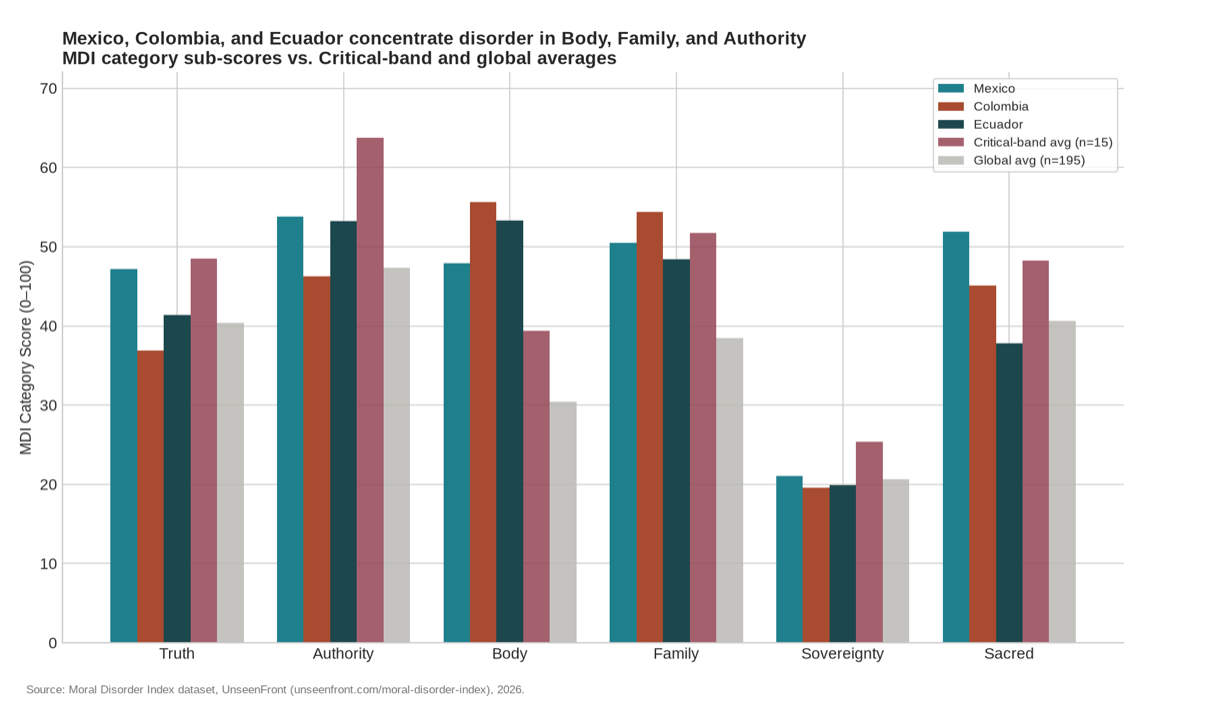
Body and Family run well above the global average across all three countries, with Colombia’s Body score exceeding even the Critical-band peer average. Source: Moral Disorder Index dataset.²
None of the three countries meets the MDI’s is_coerced threshold (coercion score ≥ 48 AND total score ≤ 50) — all three fall short on the coercion-score leg, despite Mexico and Colombia’s total scores clearing the total-score leg.3
Compliance and Sanctions Overlay
FATF
As of the June 19, 2026 FATF plenary, the grey list comprises 22 jurisdictions: Angola, Bolivia, Bosnia and Herzegovina, Bulgaria, Cameroon, Côte d’Ivoire, DRC, Haiti, Iraq, Kenya, Kuwait, Laos, Lebanon, Monaco, Nepal, Papua New Guinea, South Sudan, Syria, Venezuela, Vietnam, the British Virgin Islands, and Yemen; Algeria and Namibia were removed at this plenary.7 The blacklist remains unchanged at three jurisdictions: Iran, North Korea, and Myanmar.7 Mexico, Colombia, and Ecuador are not on either list. Notably, Bolivia and Venezuela — both in the same region — are on the grey list, showing that Latin America is not categorically exempt from FATF concern; Mexico, Colombia, and Ecuador’s clean status is a distinguishing, favorable formal signal, not a regional default.
FinCEN
On June 30, 2026, FinCEN issued Supplemental Alert FIN-2026-Alert003 on fuel smuggling and tax evasion schemes (”fiscal fuel theft”) tied to Cartel de Jalisco Nueva Generación (CJNG) and other Mexico-based transnational criminal organizations smuggling U.S. fuel into Mexico.8 The alert was issued the same day as a coordinated OFAC sanctions action against two Mexican nationals and nine entities spanning transportation, financial services, and real estate — sectors directly adjacent to consumer lending and microfinance branch networks.8,14
OFAC / Sanctions
OFAC’s Latin America-related sanctions architecture is built around cartel and criminal-network designations rather than country-wide embargoes. The Sinaloa Cartel, CJNG, and Juárez Cartel are among 20 Latin American and Caribbean organizations now designated as Foreign Terrorist Organizations, and Treasury and State have added more than 380 Latin American individuals and entities to the SDN list, with the pace of designations accelerating since May 2026.15,16 Ongoing SDN actions through mid-2026 continue to target Mexican cartel figures and their financial and logistics networks.16
Interpretation Rule
Mexico, Colombia, and Ecuador are not on the FATF grey list, and headline crime trends in Mexico are improving. Applied literally, an institutional compliance and macro screen would treat all three as clean or improving jurisdictions. The FinCEN/OFAC record shows this is incomplete: active, escalating enforcement against cartel-linked fuel smuggling, tax evasion, and financial-services front companies confirms that institutional compliance status materially understates ground-level criminal and financial-crime risk in at least the Mexican market, and by extension the MDI Authority sub-score (53.8, the highest of the three) is the more forward-looking signal than either FATF status or the declining homicide trend.
Quantitative Interpretation
Band Test
All three countries sit in the Critical band (44–49), one tier below Severe (≥50).3 This is materially above what a “high-growth, de-risking” narrative — particularly Mexico’s declining-homicide storyline — would imply. A Critical band classification signals disorder concentrated enough to be a first-order underwriting and credit variable, not a background macro consideration.
Category Concentration Test
Body and Family are the two largest drivers in all three countries, exactly matching the two sectors’ primary loss channels (mortality/morbidity and household/repayment stability). Colombia’s Body score (55.6) is the highest of the three and above the Critical-band average (39.4), driven in part by its still-elevated 25.8 per-100,000 homicide rate. Mexico and Ecuador both post Authority scores (53.8 and 53.2) near or above the Critical-band average (63.8), consistent with entrenched corruption and institutional capture independent of the crime trend in either direction. This concentration confirms the report’s sector selection: the drivers of the MDI score are the same drivers of claims and default risk, not tangential moral concerns.
Coercion Test
All three countries register Moderate-to-Low coercion (42.5, 31.3, 29.6), well under the 48-point threshold used to flag state-enforced order.3 The 195-country regression of Authority disorder on Coercion Score (R² = 0.67, slope = 0.97, p < 0.001, n = 195) shows that coercion typically rises in lockstep with authority disorder — yet Mexico, Colombia, and Ecuador all sit noticeably below the regression line for their level of Authority disorder (see Figure 2).2 That gap means their disorder is not being artificially suppressed by state coercion; it is socially and structurally embedded — a form of disorder that is more durable and predictable for underwriting purposes than politically coerced “order” would be, but also less likely to improve through political liberalization alone.
Figure 2. Authority disorder as a predictor of state coercion
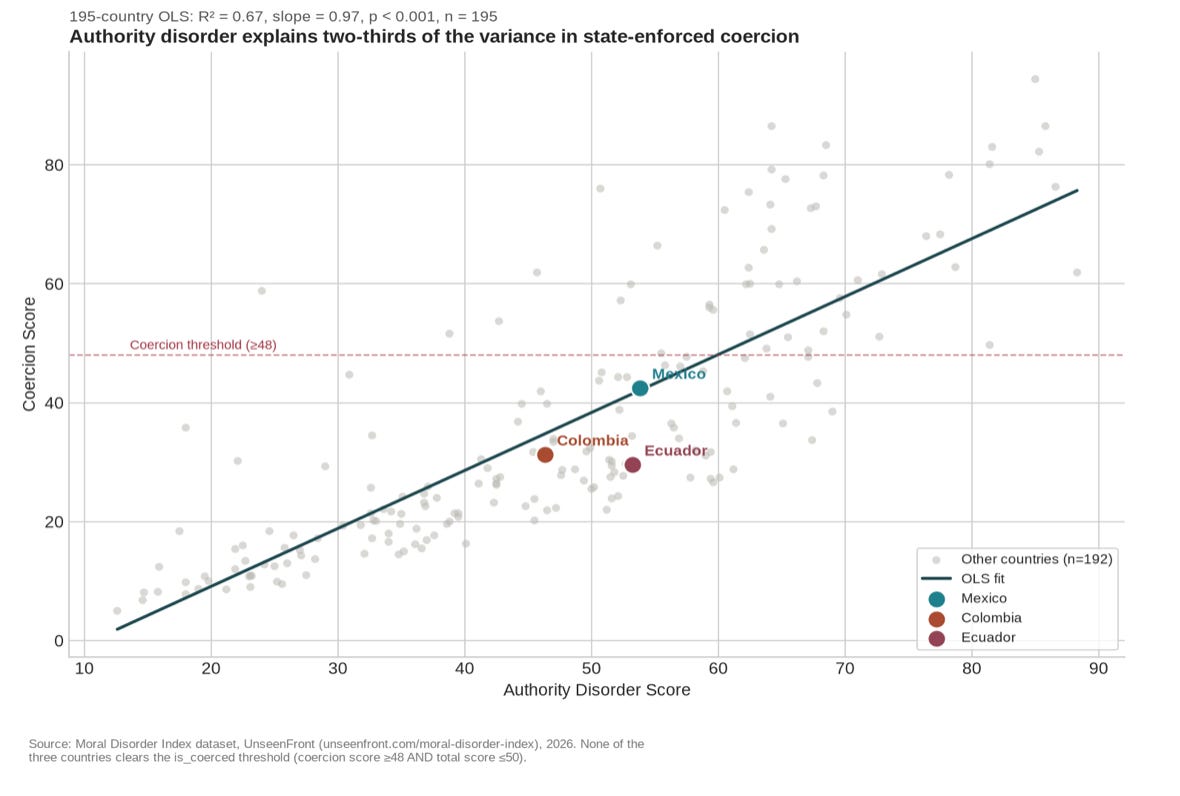
An OLS regression of Coercion Score on Authority disorder across all 195 MDI-indexed nations shows Mexico, Colombia, and Ecuador falling below the fitted line — their disorder is structurally embedded rather than state-enforced. Source: Moral Disorder Index dataset; authors’ OLS calculation.²
Compliance Overlay Test
The FATF signal (clean) and the FinCEN/OFAC signal (active, escalating cartel-finance enforcement in Mexico) point in different directions. This is a criminal-network problem layered on top of, not replacing, an institutional-integrity problem: FATF measures a country’s AML/CFT regulatory framework, while FinCEN and OFAC are responding to what criminal networks are actually doing inside and through that framework. For Mexico specifically, the compliance overlay corroborates — rather than contradicts — the elevated MDI Authority score.
Decision Relevance Test
Underwriting assumptions for Mexican life and health books should not be relaxed solely on the basis of the declining 2025 homicide trend; Authority-driven claims and fraud risk has not improved in parallel.
Ecuadorian mortality and health underwriting should be repriced upward given the 30% year-over-year homicide surge, which the MDI Body sub-score had already flagged as elevated relative to peers.
Consumer credit and microfinance risk models in all three markets should treat Family-driven repayment-culture risk as structural, not cyclical, given scores 10–16 points above the global average.
Enhanced due diligence should be triggered for any Mexican-market lending, insurance, or real-estate counterparty with exposure to transportation, logistics, or financial-services intermediaries named or typologically adjacent to the June 2026 FinCEN alert.8
Decision Relevance
Taken together, the Band, Category Concentration, Coercion, and Compliance Overlay tests converge on a single practical conclusion: Mexico, Colombia, and Ecuador should be priced, underwritten, and lent into as Critical-band moral-disorder markets with durable, structurally embedded (not politically coercive or transient) risk — regardless of which direction headline crime statistics are moving in any given year. Clean FATF status is a necessary but insufficient signal; it should be read alongside, not instead of, MDI category scores and active FinCEN/OFAC typology alerts.
Recommendations
For B2C Readers
If your pension fund, mutual fund, or insurance provider holds Latin American life, health, or consumer-lending exposure, understand that a “growth market” pitch built on urbanization and rising incomes can coexist with structurally high rates of violence, family instability, and institutional corruption. Mexico’s falling homicide rate is genuinely good news, but it does not mean the underlying corruption and cartel-finance risk that shapes insurance costs and loan pricing has fallen with it.
For Investors
Do not treat a declining national homicide rate as a broad de-risking signal; disaggregate by MDI category before adjusting country exposure limits, particularly for Mexico where Authority risk is stable-to-elevated.
Widen the country risk screen beyond FATF status alone; incorporate MDI Total score and category concentration as a standing input for Latin American allocations.
Treat Ecuador’s 2025–2026 homicide surge as a confirming, not surprising, data point — the MDI Body sub-score already signaled above-average risk before the crisis fully materialized.
For Insurers and Reinsurers
Reprice Ecuadorian life and health treaties to reflect the 50.9 per-100,000 2025 homicide rate and its trend; do not average it into a regional blend that dilutes the signal.
For Mexico, hold mortality and morbidity assumptions steady rather than relaxing them in response to the declining crime headline; fraud and claims-integrity risk tracks Authority, which has not improved.
Use Family sub-scores as a reserving input for health and disability lines tied to household-stability-linked claims behavior.
For Lenders and Microfinance Institutions
Treat Family-driven repayment-culture risk (all three countries 10+ points above global average) as a structural underwriting variable in credit-scoring models, not a soft factor.
Apply enhanced branch-security and cash-handling protocols in Ecuador given the confirmed 2025 homicide surge, and reassess microfinance footprint expansion plans accordingly.
Screen borrower and merchant counterparties in Mexico against sectors named in the June 2026 FinCEN alert (transportation, financial services, real estate) before expanding lending relationships.
For Operators and Compliance Teams
Require enhanced due diligence on any Mexican counterparty in transportation, logistics, financial services, or real estate given the active FinCEN/OFAC enforcement pattern, irrespective of clean FATF status.
Do not rely on FATF grey-list absence as a standalone compliance clearance for Mexico, Colombia, or Ecuador; layer in MDI Authority scores and FinCEN typology alerts for jurisdiction scoring.
Monitor for continued OFAC SDN designations tied to Mexican cartel financial networks, given the accelerating pace of designations since May 2026.15
Conclusion
The data reject the null hypothesis. Mexico, Colombia, and Ecuador’s growth narrative for life, health, and credit markets is not free of elevated moral-disorder risk — all three sit in the MDI’s Critical band, driven principally by Body and Family disorder, the two categories most directly tied to mortality, morbidity, and repayment behavior. Because coercion levels are Moderate-to-Low, this disorder is structurally embedded rather than a product of suppressible state repression, making it a durable rather than transient underwriting variable. Clean FATF status across all three countries is real and favorable, but the June 2026 FinCEN alert and coordinated OFAC action confirm that formal compliance clearance can understate active, ground-level financial-crime exposure — most acutely in Mexico, where a seven-year-low homicide rate has not been accompanied by any corresponding improvement in the MDI’s Authority score. Latin America’s growth markets are not a moral-panic story, but they are not a low-friction growth story either: they are a Critical-band structural risk that conventional macro and even improving-crime narratives will systematically underprice unless MDI category data and compliance typology alerts are used as standing inputs alongside GDP and penetration statistics.
Sources
1. Regional insurance and consumer-credit penetration context — market narrative synthesis.
2. Moral Disorder Index dataset, UnseenFront. unseenfront.com/moral-disorder-index
3. MDI Methodology v3.1.5 — category weights, band thresholds, and Coercion Index formula, UnseenFront. unseenfront.com/moral-disorder-index
4. InSight Crime. InSight Crime’s 2025 Homicide Round-Up. insightcrime.org/news/insight-crime-2025-homicide-round-up/
5. InSight Crime. InSight Crime’s 2025 Homicide Round-Up. insightcrime.org/news/insight-crime-2025-homicide-round-up/
6. Reuters. (2026, January 20). Murders in Ecuador jump 30% in 2025. reuters.com/world/americas/murders-ecuador-jump-30-2025-2026-01-20/
7. FATF. Black and grey lists (June 2026 plenary update). fatf-gafi.org/en/countries/black-and-grey-lists.html; U.S. Treasury. READOUT: Financial Action Task Force’s June 2026 Plenary. home.treasury.gov/news/press-releases/sb0547
8. FinCEN. (2026, June 30). FinCEN Issues Supplemental Alert on Fuel Smuggling and Tax Evasion Schemes Southern... fincen.gov/news/news-releases/fincen-issues-supplemental-alert-fuel-smuggling-and-tax-evasion-schemes-southern
9. The Washington Post. (2026, June 30). Treasury sanctions Mexico cartel network. washingtonpost.com/business/2026/06/30/treasury-mexico-cartels-ofac-fincen/
10. OECD Family Database. Share of births outside marriage. webfs.oecd.org/els-com/Family_Database/SF_2_4_Share_births_outside_marriage.pdf
11. El Comercio (Ecuador). Menos nacimientos y más madres solas en Ecuador. elcomercio.com/sociedad/menos-nacimientos-y-mas-madres-solas-en-ecuador/
12. CEPAL/Observatorio de Igualdad de Género. Child marriage infographic. oig.cepal.org/sites/default/files/c2200635_web_0.pdf
13. OAS/MESECVI. Hemispheric Report on Child Marriage. oas.org/es/mesecvi/docs/matrimonio_infantil_eng_v2.pdf
14. OFAC. Recent Actions (2026-07-15). ofac.treasury.gov/recent-actions/20260715
15. Miller & Chevalier. Where FTO-Designated Cartels Operate: 2026 Update. millerchevalier.com/publication/where-fto-designated-cartels-operate-2026-update
16. OFAC. Sanctions List Search. sanctionssearch.ofac.treas.gov/