
On May 10, 2007, Purdue Frederick and three of its executives plead guilty to federal charges of misbranding OxyContin’s addiction risk. The company ended up paying $634.5 million in penalties. The market adjusted and assumed the costs were absorbed.

But, after the fine was placed, the families distributions increased significantly. Roughly $10.7 billion left the company between 2008 and 2017, against about $1.3 billion in the twelve years before.
Years later, Purdue was in Chapter 11. The estate’s settlement climbed to $7.4 billion. Its assets and operations were transferred to a new public benefit corporation named Knoa Pharma, owned by the Knoa Foundation, which is dedicated to public health and opioid abatement.
The entire equity value of the firm was wiped out and the settlement took most of the owners distributions.
The questions that interested us from here were (1) why the market failed to price any post-conviction risk realization, and (2) whether this is some sort of bigger pattern.
So we did the following:
We ran five historical cases backwards,
stood at a documented decision point using only what was knowable that day,
asked what a disciplined reading of the moral fragilities in the business would have flagged,
then compared our findings to what had happened.
Five decision points
Purdue Pharma, May 11, 2007. The day after the plea.
On the record that day:
a federal conviction for misrepresenting addiction risk,
a 2003 GAO report documenting abuse, diversion, and aggressive marketing,
and a revenue base concentrated in the heaviest-using patients.
Outcome: bankruptcy in 2019, a DOJ resolution above $8.3 billion in 2020, dissolution. The White House CEA later estimated the opioid crisis cost $504 billion in 2015 alone - about fourteen times Purdue’s entire earnings.
Tobacco, May 24, 1994. The day after Mississippi filed the first state Medicaid-recovery suit. The industry had won essentially every individual smoker suit for the previous four decades, and it treated lawsuits as a cost it could manage. Four years later came the Master Settlement Agreement: 46 states, at least $206 billion over the first 25 years, with payments continuing in perpetuity. Cumulative payments reached $165 billion through 2024 and continue. The outcome is a permanent retroactive tax.
Wells Fargo, 2013. The year the Los Angeles Times documented it’s sales culture. The cross-selling that drove the bank’s valuation premium worked better when customers misunderstood, and the compensation system paid out. The penalties, when they came in 2016, were $185 million. Small for a bank that size. The real cost came in 2018: the Federal Reserve’s asset cap, freezing the bank at roughly $1.95 trillion, not lifted until June 2025, seven years later. Estimated cost: about $39 billion in foregone earnings. Roughly twelve dollars of blocked growth for every dollar of fine.
MindGeek, 2019. The year California prosecutors charged the GirlsDoPorn producers, whose content was monetized on Pornhub, while advocacy groups built the public case against the platform. The entire revenue model ran through two payment networks. On December 4, 2020, the New York Times published Kristof’s “The Children of Pornhub”. Mastercard and Visa suspended payments on December 10. Within days the major networks were gone. Pornhub purged roughly 10 million unverified videos, about 80 percent of its content, and the company was sold under distress in 2023. The direct penalties were trivial at $1.84 million. But the business model was destroyed in ten days.
Corporate Russia, March 2014. Crimea is annexed and the first sanctions hit. Every Western firm with major Russian exposure got hit with the same question: is this jurisdiction’s apparent stability real, or enforced? But there was already precedent for this here. The Yukos expropriation, beginning in 2003, had shown the courts working as a weapon of the state against a commercial target. Country-risk models price swings. They fail at pricing full on seizures. After February 2022: BP took a $25.5 billion pretax charge on its Rosneft stake. ExxonMobil impaired Sakhalin-1 and was then expropriated outright by decree, exiting empty-handed. Russia then enforced a mandatory sale discount of at least 50 percent, an exit tax later raised to 35 percent with the discount raised to 60 percent. Confirmed direct losses to foreign firms exceed $170 billion.
The clock
Line the five up and you get to see a clock in the making.
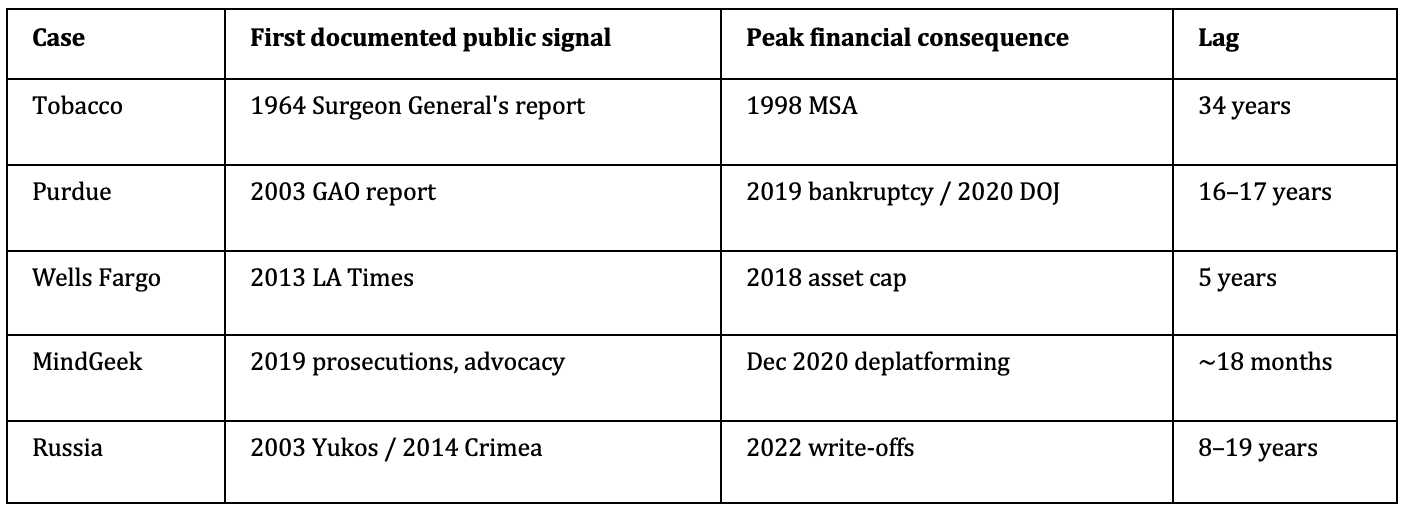
Two things stand out from the above cases.
First, every case gave years of documented warning. The shortest gap between a warning sign and a real consequence in this sample is about eighteen months. Nothing here was a surprise. The information was public, often federal, sometimes criminal.
Second, the clock has two speeds, like the second hand and the minute hand. The slow hand runs while damage is piling up on someone else’s budget: decades for tobacco, years for opioids. The fast hand starts when someone forces that cost back onto the balance sheet. Mississippi’s 1994 filing was such a tool: the MSA followed in four years, after thirty years of slow clock. The GirlsDoPorn prosecutions and the advocacy record were the tool forming around Pornhub; the trigger, when it came, took ten days. Courts and legislatures take five to thirty years. Two payment networks protecting their own franchises took ten days.
The Pornhub trigger is commonly misread. The Kristof column contained little that advocacy groups had not documented for two whole years. What the column added was a mainstream voice. Under sustained, documented pressure, you cannot predict when the detonator goes off but in this case you could have predicted it would.
The bill
The second pattern is what the final bill looks like. In every one of these five cases, fines and settlements were the smallest part of it.
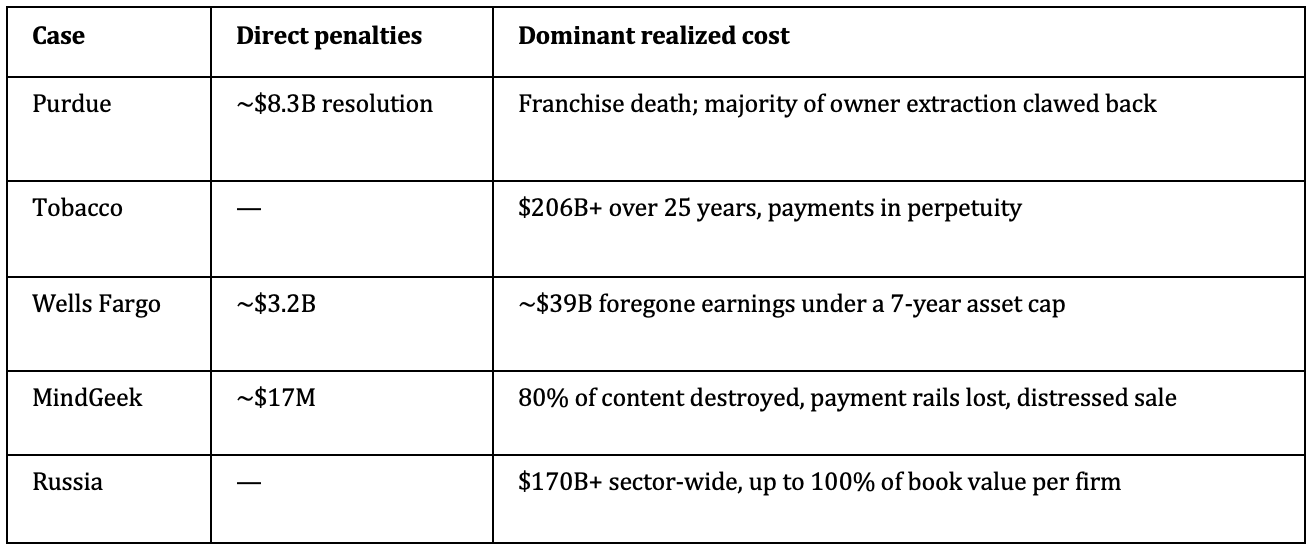
The big money left. A regulator froze the bank's growth for seven years. Two payment networks pulled the rails out from under the platform. The courts turned tobacco's settlement into a permanent tax. The state took the oil assets outright. A risk model built on penalty benchmarks would have missed more than 90 percent of the Wells Fargo bill alone. And the losses? All significant, but different. Purdue died. Tobacco pays forever. Wells lost seven years of growth. MindGeek lost its model in ten days. Russia took up to everything on the books.
What five failures cannot tell
We picked these five cases because the bill was there to see. A sample chosen this way can tell you how big, what shape, how long the fuse. It cannot tell you how often this bill comes reckoning. For every Purdue there may be a dozen comparably exposed firms that carried the same fragility and walked away. Reading base rates out of a failure sample is the oldest error in risk writing. So there is more to do.
The honest claims from this work are conditional ones. What the record here does not show is the denominator: how many carried the exposure and never paid. This requires different work: assemble the full cohort of comparably exposed firms at the same starting date, including the ones nothing happened to, and follow everyone. We did that. The results, including the cohort where everyone paid and the nearly identical cohort where only two in ten did, are the subject of the companion essay.
This essay summarizes the historical backtest work behind UnseenFront’s Moral NPV methodology. Every figure is drawn from primary or high-quality secondary sources linked in the text. The MDI dataset and methodology (license: CC BY-NC-SA 4.0) are published on the Open Science Framework.