
Overview
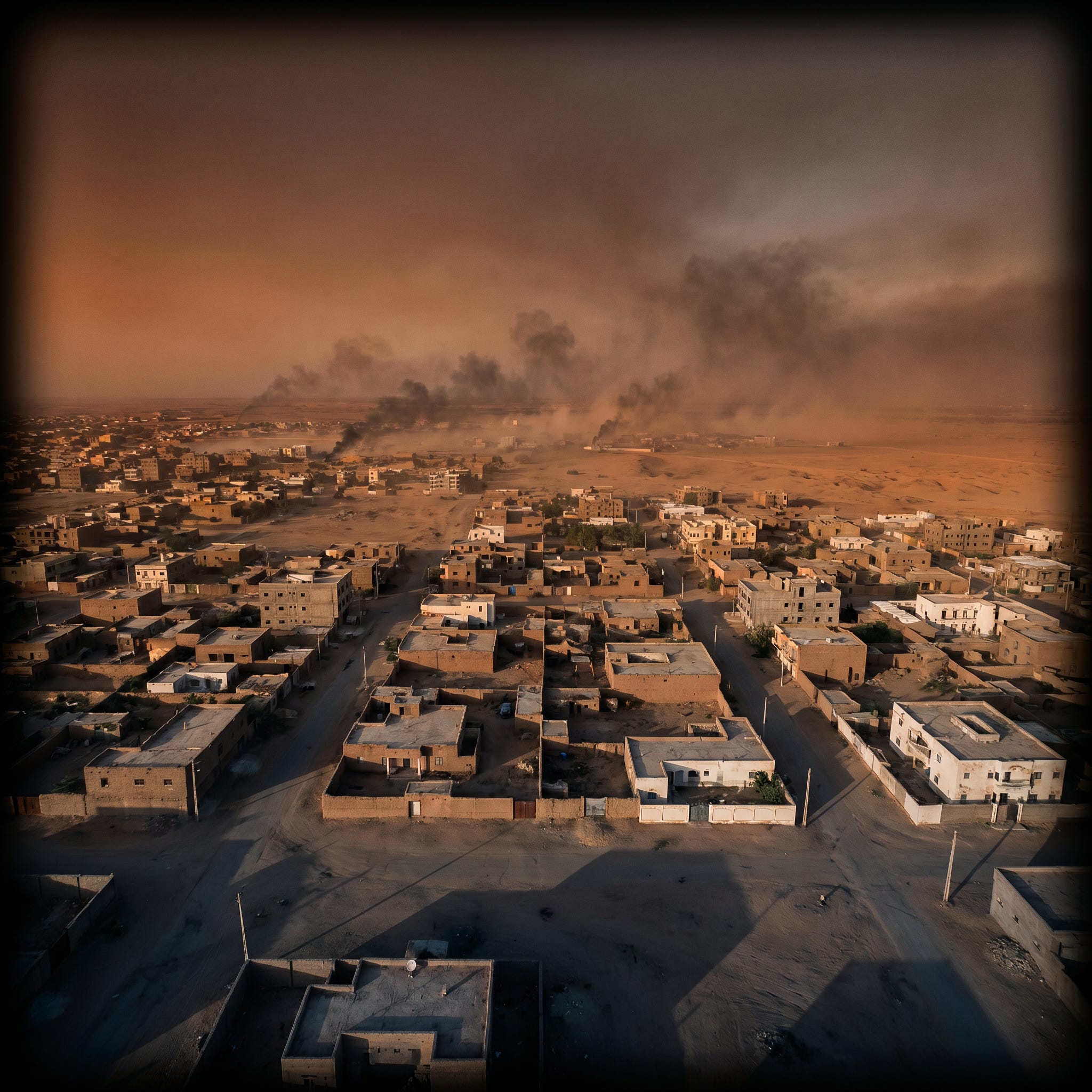
Approximately 700,000 people — 500,000 residents plus an estimated 200,000 internally displaced persons who sought refuge there — are now trapped inside El Obeid, the capital of Sudan’s North Kordofan state. The Rapid Support Forces (RSF) have tightened an encirclement carrying the precise structural markers of the siege that destroyed El Fasher twelve months prior. On 20 June 2026, the UN Security Council issued a rare presidential statement warning of an “imminent risk of mass atrocities” and demanding the RSF halt its assault (UN News, 2026, June 20). Within 48 hours, the RSF launched a fresh drone wave.
This briefing applies the Moral Disorder Index (MDI) — a 195-country diagnostic framework measuring societal breakdown across seven dimensions — to analyse both Sudan’s position in the global disorder landscape and the specific mechanisms of “strategic silence” enabling the RSF’s advance. The argument is structural: El Obeid is not a surprise. It is the arithmetically predictable outcome of documented state complicity, accelerating humanitarian erosion, and a media environment incapable of sustaining attention.
Part I: The Siege — Eighteen Months in Five Phases
El Obeid has effectively been under RSF pressure since the war’s outbreak on 15 April 2023. Human Rights Watch confirmed in June 2026 that the city has experienced “18 months of siege-like conditions” (Human Rights Watch, 2026, June 26). Five distinct phases define the escalation:
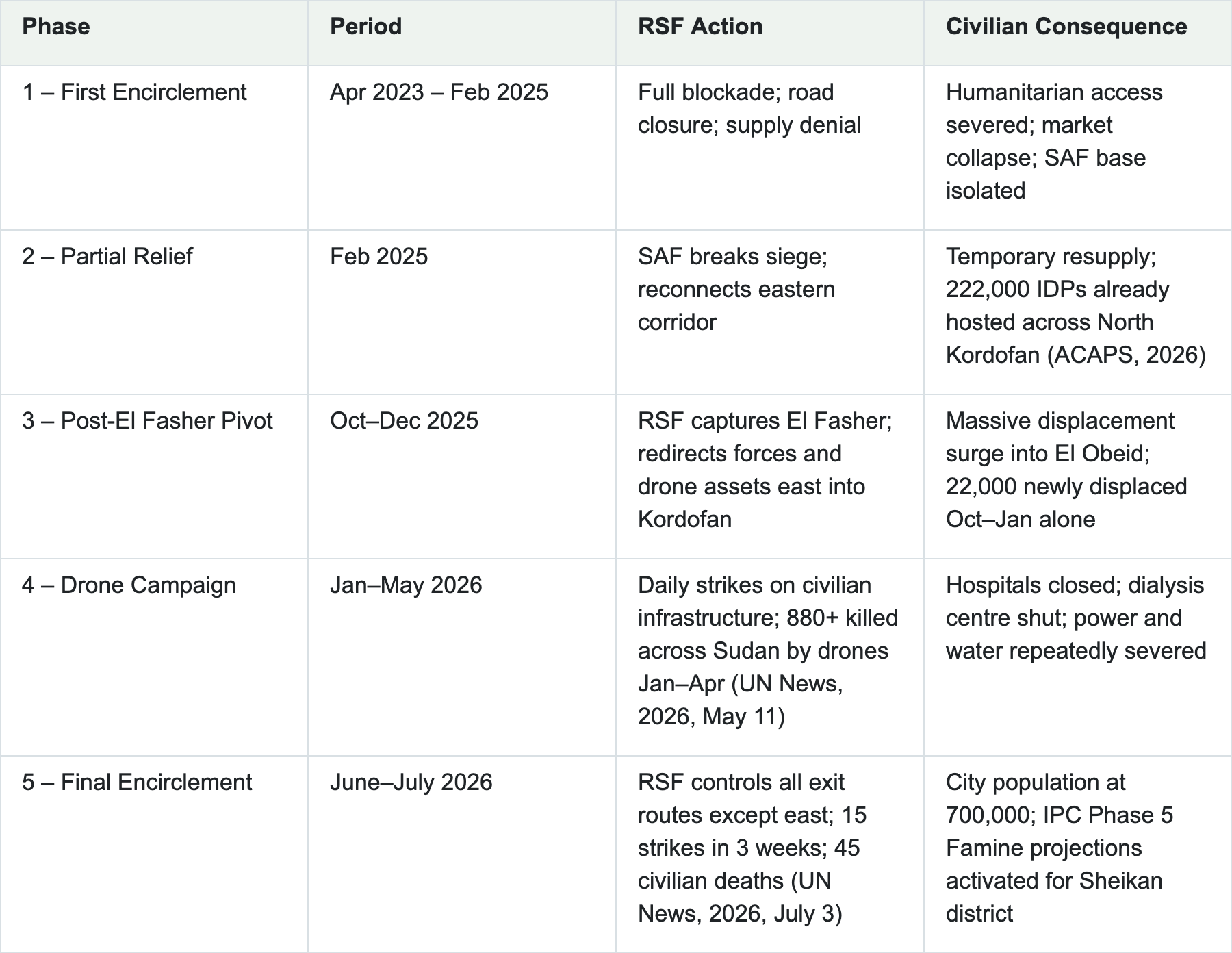
The drone campaign is not incidental; it mirrors the documented RSF doctrine of infrastructure destruction as a ground-assault precursor. Drones caused over 80% of all civilian deaths in Sudan in the first four months of 2026 (UN News, 2026, May 11). In El Obeid, targets follow a deliberate logic: the main power transformer (blacked out 19 June), the dialysis centre, fuel stations, a market, a private girls’ school, and civilian vehicles on exit routes (OCHA, 2026, June 22). Reuters journalists entering the city in January 2026 found satellite imagery from Yale’s Humanitarian Research Lab showing approximately 100 new grave mounds appearing in two local cemeteries within a two-week window (Reuters, 2026, January 21).
Why El Obeid matters strategically: The city is the nodal point through which Sudan’s economic geography converges. It controls five arterial corridors linking Khartoum to Darfur, Kordofan, White Nile State, and South Sudan. Sudan’s sole functioning oil pipeline — which transports approximately 94% of South Sudan’s national budget revenue in crude — transits North Kordofan (African Security Analysis, 2026). El Obeid hosts the world’s largest gum Arabic exchange. And for the RSF — having lost its Khartoum-based parallel government in March 2025 — the city represents the eastern anchor of a contiguous territorial arc from the Libyan border to Sudan’s geographic centre, the “political project” analyst Ahmed Ben Omer described to Al Jazeera as the RSF’s post-Khartoum survival strategy (Al Jazeera, 2026, July 6).
Part II: The Atrocity Template — What El Fasher Predicts
The RSF’s post-victory conduct is not speculative. It is forensically documented. Amnesty International’s July 2026 report City Under Siege, Children Under Fire, based on 247 interviews — including 39 children — and 89 verified videos, concluded without qualification that the RSF committed crimes against humanity and ethnic cleansing during its El Fasher campaign (Amnesty International, 2026, June 30). The UN’s Independent International Fact-Finding Mission (FFM) found El Fasher massacres bore the “hallmarks of genocide” (Human Rights Watch, 2026, June 26).
ACLED documented over 1,300 civilians killed in the first week of RSF control in El Fasher — called “the most deadly week of the war” — noting this a conservative count given rapid mass grave proliferation (ACLED, 2025, December 11). The documented playbook includes: executions at berm escape routes (where RSF fighters told civilians they “would fill the berm with bodies”); killings inside a protected maternity hospital; mass sexual violence including against girls as young as 13; shipping-container detention centres where men died of heat and dehydration; and the systematic burning of Zaghawa villages after residents had already fled — evidencing ethnic intent to render areas permanently uninhabitable (Amnesty International, 2026, June 30). RSF fighters routinely used the Arabic term falangay — meaning slavery — during attacks on non-Arab communities. Nine of 19 verified execution videos show named RSF commander Abu Lulu personally executing civilians in plain clothing.
UN High Commissioner Volker Türk stated on 18 June 2026: “We have seen this playbook before. We know where it led then, and cannot allow a repeat of the preventable atrocities we documented in El Fasher and Zamzam IDP camp” (Human Rights Watch, 2026, June 26). El Obeid’s 200,000 newly-displaced residents — who fled there precisely to escape the RSF — are now at risk of meeting the same forces they fled, with no exit route available.
Part III: The Moral Disorder Index — Sudan’s Position and the Architecture of Silence
Sudan’s MDI Profile
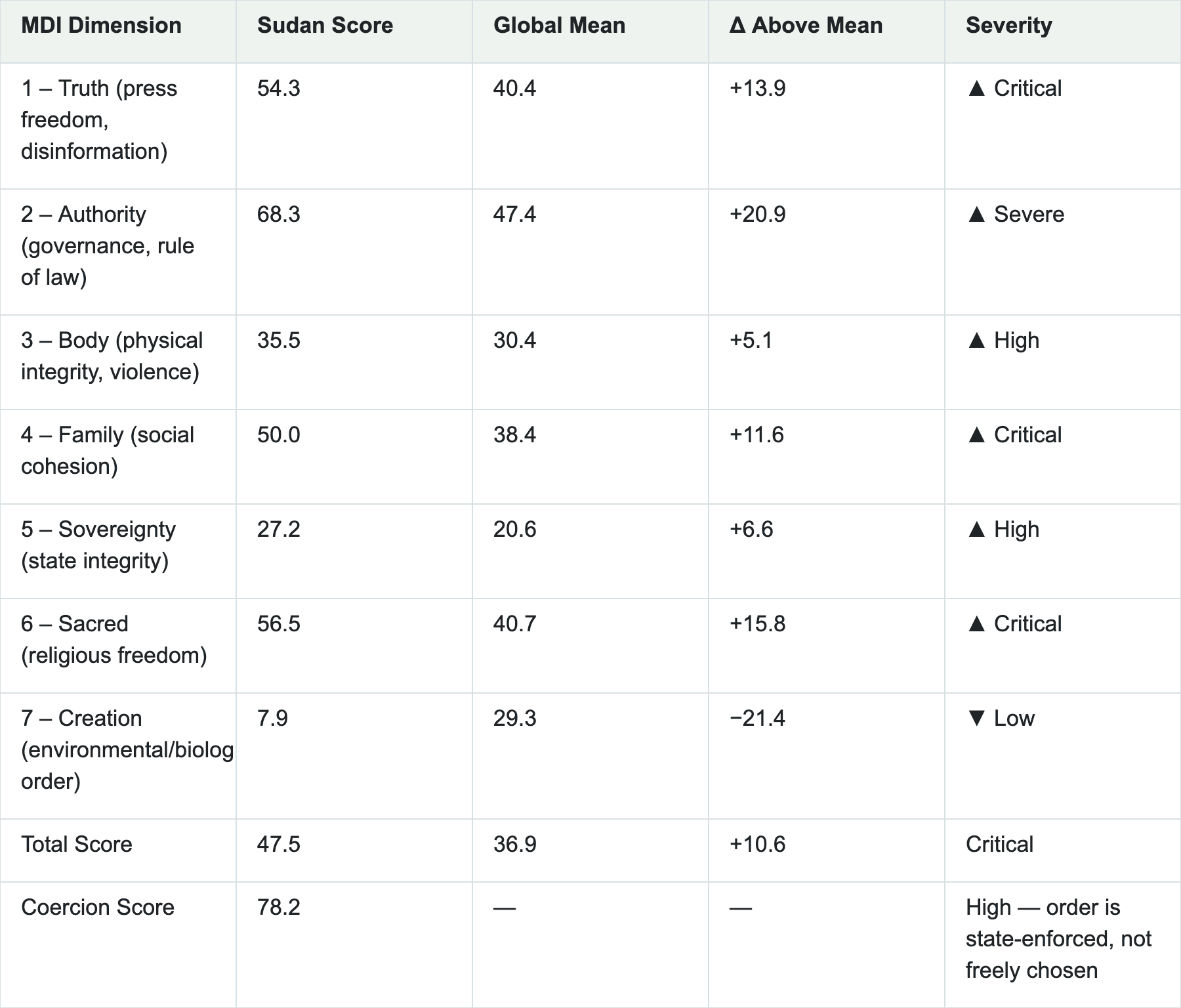
The MDI assesses 195 countries across seven dimensions of moral and institutional disorder, scored 0–100 (higher = greater disorder). Sudan’s current profile (Run Date: July 1, 2026) places it at Rank 11 of 195 — within the top 6% most disordered nations on earth, in the Critical band, and on a worsening trend.
Source: Moral Disorder Index, July 1, 2026 run, n = 195 countries.
Two dimensions are analytically decisive for the El Obeid briefing. The Authority score (68.3) — the highest in Sudan’s profile and 20.9 points above the global mean — reflects “severe government corruption, lawlessness, or totalitarian control of institutions,” directly mapping to the RSF’s impunity and the SAF’s failure to protect civilians under its nominal control. The Coercion Score (78.2) is critical: the MDI flags that Sudan’s apparent order is not voluntary but state-enforced, meaning that even relatively lower-scoring dimensions represent compliance under threat, not functional governance. The RSF embodies this principle — the coercive imposition of order that has none of the properties of legitimate authority.
The Truth score (54.3), 13.9 points above the global mean, quantifies the information environment in which El Obeid is being allowed to deteriorate: systematic disinformation, suppression of free expression, and media manipulation are structural features of the Sudanese state, not exceptional wartime conditions. This score has a direct relationship to the “media failure” dimension of strategic silence — when the state itself suppresses truth, external media operates in a degraded information environment that enables neglect.
The Visualization: Sudan vs. UAE vs. Global Mean
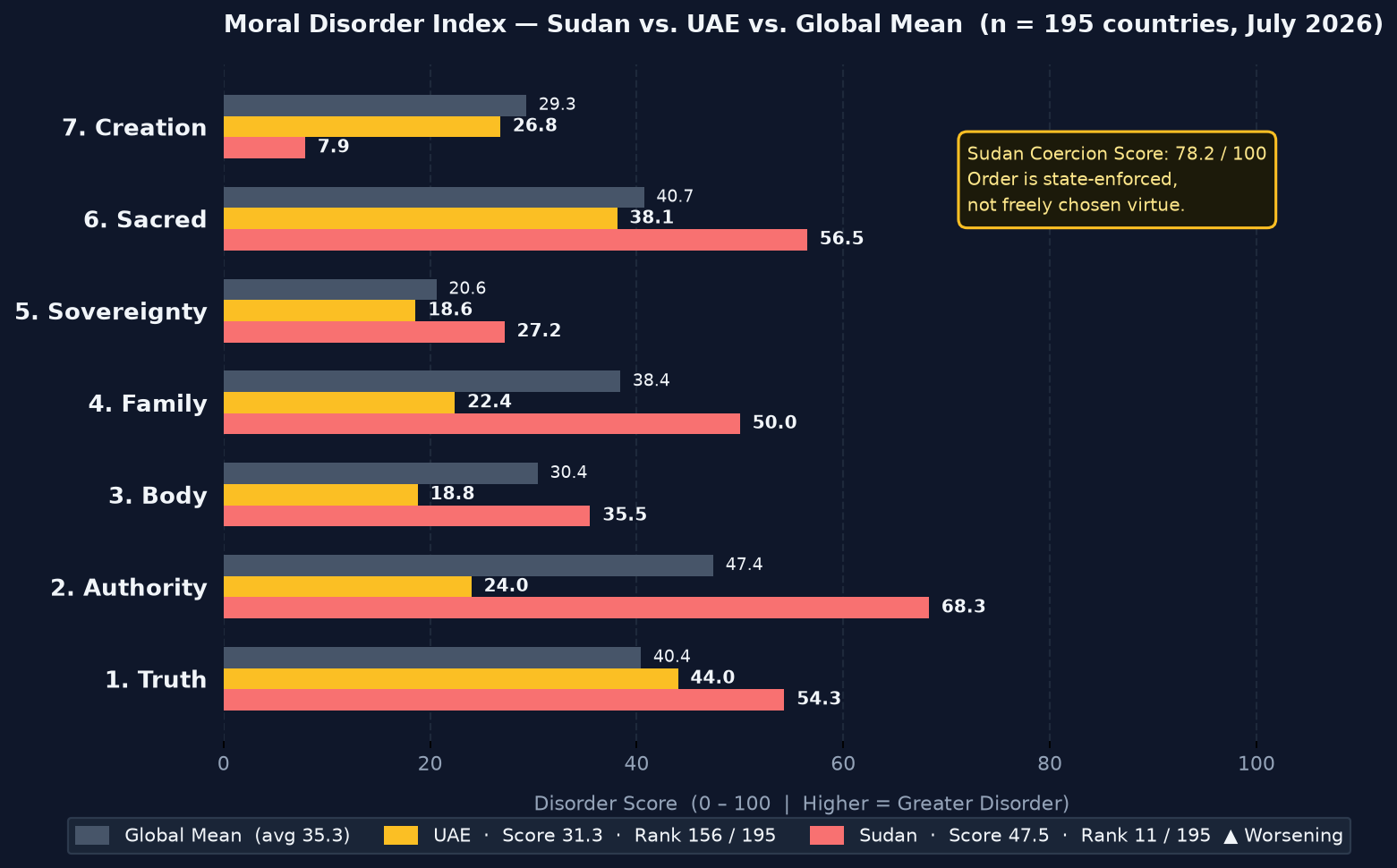
The radar chart above plots Sudan’s seven MDI dimension scores against the global mean and the UAE — the RSF’s primary external weapons supplier, as documented by the UN Panel of Experts on Sudan (2024) and Reuters (2023). The contrast is structurally important: the UAE scores 31.3 (Rank 156 of 195, “Concerning” band) — far below Sudan’s disorder levels — yet materially enables the atrocity apparatus producing that disorder. UAE weapons and drone systems (likely Chinese-made FH-95s supplied through UAE channels) are documented as the primary driver of the 600% increase in drone-related deaths across 2024–2025 (Council on Foreign Relations, 2026). The UAE’s relatively low Authority score (24.0) reflects a functioning state apparatus — one with the institutional capacity to stop arms flows it is choosing not to stop.
This is the precise geometry of strategic silence: a Critical-band state (Sudan, Rank 11) being supplied by a Concerning-band state (UAE, Rank 156) with zero binding consequence.
The Three Dimensions of Strategic Silence
State Complicity. The conflict’s sustainability depends on external supply chains no non-state actor could self-maintain. The UAE provides consistent material support to the RSF, including weapons, drones, and logistical backing, “often under the guise of humanitarian or commercial partnerships” (Kenny, 2025, Critical Debates in Humanities and Social Sciences). Arms shipments are funneled through Chad and Libya to RSF-controlled areas, as documented by both Reuters (2023) and the UN Panel of Experts (2024). The RSF’s gold mines in Darfur — a primary war-financing mechanism — export through South Sudan to the UAE, where proceeds are converted to weapons and returned into the conflict economy (The Soufan Center, 2026, April 21). Egypt simultaneously provides the SAF with “staunch political backing, logistical support, and technical support,” including use of the East Oweinat airstrip for strikes on RSF positions. Both primary external sponsors sit within the diplomatic coalitions formally tasked with peace mediation.
Humanitarian Erosion. North Kordofan faces IPC Phase 5 (Famine) projections for Sheikan district in 2026, with ACAPS explicitly warning that “logistics strangulation” mirrors the famine conditions that developed in El Fasher and Kadugli (ACAPS, 2026, February 11). UNICEF reported 140 children admitted for severe acute malnutrition in Sheikan and Al Rahad in January 2026 alone. Affan et al. (2024) document that against a humanitarian need of 2.7billion,only2.7 billion, only 2.7billion,only323 million was contributed — a funding ratio of approximately 12% (Affan et al., 2024, BMJ Paediatrics Open). Fadul (2025) demonstrates the disparity explicitly: Sudan’s humanitarian response was 63% funded in 2024 versus 73% for the Occupied Palestinian Territory — not a function of need but of attention (Fadul, 2025, BMJ Global Health). The RSF targeted and killed five Sudanese Red Crescent volunteers during official food distribution in Bara in October 2025, and attacked a humanitarian convoy en route to El Obeid on 26 June 2026, destroying 50 tonnes of flour (CFR, 2026).
Media Failure. Sudan’s MDI Truth score (54.3 — 13.9 above global mean) quantifies a structural information deficit that predates the war. Vella Gregory (2024) provides the academic framing in Public Humanities: the crisis “does not seem to overly trouble the media in the Global North,” a pattern traceable to colonial-era communication suppression that rendered Sudanese populations institutionally invisible to northern information systems (Vella Gregory, 2024, Public Humanities). Kenny (2025) identifies a complementary discursive mechanism: official diplomatic and media language consistently frames Sudan as a “failing state” with internally produced dysfunction, positioning the international community as neutral rather than structurally complicit — a framing that obscures the UAE weapons pipeline and the gold-market enabling that sustain the RSF. By early 2026, diplomatic momentum had dissipated as Western attention shifted to the US-Israel-Iran confrontation (The Soufan Center, 2026, April 21). The UN FFM — the primary investigative mechanism — remained “unable to meaningfully fulfil its mandate” due to a UN hiring freeze and funding shortfall as late as April 2024 (Amnesty International, 2024, April 12).
Final Insights: MDI Scores and the Test of Accountability
Sudan’s MDI profile — Total Score 47.5, Rank 11/195, Critical band, worsening trend, Coercion Score 78.2 — quantifies a country in which every institutional safeguard against atrocity has been systematically degraded. The Authority dimension (68.3) sits at the apex of disorder, translating directly into RSF impunity: no domestic accountability mechanism, no enforceable ceasefire, no judiciary, no independent press capable of generating sustained internal pressure. The Truth dimension (54.3) confirms that this is an information environment structurally hostile to documentation and accountability, making external media the sole oversight mechanism — and that mechanism is failing.
The MDI comparison with the UAE (Score 31.3, Rank 156, Concerning band) crystallises the moral geometry of the crisis. A state with functioning institutions and the lowest Authority score in this comparative set (24.0 — reflecting relatively clean governance) is materially arming a conflict engine scoring 68.3 on the identical dimension. This is not a failure of knowledge or capacity. It is a choice that the current accountability architecture has no mechanism to punish.
The Security Council’s 20 June 2026 statement — demanding the RSF halt its assault, warning of mass atrocity risk — contained no enforcement mechanism, no red line, and no consequence. The African Union failed at its first post-war summit to include Sudan as a standalone agenda item (Amnesty International, 2024, April 12). The ICC’s jurisdiction has not been extended beyond the original 2005 Darfur referral. Named perpetrators — including Abu Lulu, documented in nine verified execution videos — remain at liberty.
El Obeid represents a categorical test of whether international accountability retains deterrent function after El Fasher demonstrated it does not. What is being measured now is not whether the RSF will follow its template — the template is documented — but whether the documented template, in combination with an MDI-verified institutional collapse score of 47.5 and a coercion index of 78.2, is sufficient to trigger the mechanisms that exist precisely for this scenario. The answer, as of July 2026, remains no.
Vella Gregory’s (2024) summation carries the weight of the entire analysis: “When that moment arrives, it is the silence of those in power that we will remember most.”
Minimum accountability actions required (per HRW, Amnesty International, OHCHR):
UN Human Rights Council urgent session on El Obeid; FFM inquiry mandate activated (HRW, 2026)
UN Security Council extension of ICC jurisdiction to all Sudanese territory (HRW, 2026)
Immediate arms embargo extended country-wide; UAE named and sanctioned (Amnesty International, 2026, June 30)
International protection force deployment (Affan et al., 2024; Amnesty International, 2026)
Targeted sanctions against named perpetrators including Abu Lulu and supply-chain financiers
References
Abdellah, A., Elamin, A., ElAbbadi, A., Hakim, A., Ansah, J., Wagiallah, N., & Abdullah, S. (2024). Sudan: from a forgotten war to an abandoned healthcare system. BMJ Global Health, 9(10), e016406. https://doi.org/10.1136/bmjgh-2024-016406
ACAPS. (2026, February 11). Conflict-induced displacement in North and South Kordofan. https://www.acaps.org/fileadmin/Data_Product/Main_media/20260211_ACAPS_Sudan_-__Conflict-induced_displacement_in_North_and_South_Kordofan.pdf
ACLED. (2025, December 11). Fighting moves to Kordofan as Sudan’s east–west divide solidifies. https://acleddata.com/report/fighting-moves-kordofan-sudans-east-west-divide-solidifies
Affan, A., Goldhagen, J., & Elkrail, S. E. (2024). Responding to the humanitarian crisis in Sudan. BMJ Paediatrics Open, 8(1), e002893. https://doi.org/10.1136/bmjpo-2024-002893
Al Jazeera. (2026, July 6). El-Obeid under siege by RSF: Could this be Sudan’s next el-Fasher? https://www.aljazeera.com/news/2026/7/6/el-obeid-under-siege-by-rsf-could-this-be-sudans-next-el-fasher
Amnesty International. (2024, April 12). Sudan: One year since conflict began, response from international community remains woefully inadequate. https://www.amnesty.org/en/latest/news/2024/04/sudan-one-year-since-conflict-began-response-from-international-community-remains-woefully-inadequate/
Amnesty International. (2026, June 30). Sudan: RSF atrocities in El Fasher ‘a stain on the conscience of humanity’. https://www.amnesty.org/en/latest/news/2026/07/sudan-rsf-atrocities-in-el-fasher-a-stain-on-the-conscience-of-humanity-new-report/
Council on Foreign Relations. (2026). Civil war in Sudan: Global conflict tracker. https://www.cfr.org/global-conflict-tracker/conflict/power-struggle-sudan
Fadul, N. (2025). Addressing systemic inequities in humanitarian response: a framework for coordinated response in Sudan’s neglected health crisis. BMJ Global Health, 10(3), e017533. https://doi.org/10.1136/bmjgh-2024-017533
Human Rights Watch. (2026, June 26). Sudan: Urgently address the situation in and around El Obeid. https://www.hrw.org/news/2026/06/26/sudan-urgently-address-the-situation-in-and-around-el-obeid-take-bold-steps-towards
Kenny, F. (2025). Profiting from instability: Disaster capitalism and accountability in Sudan’s civil war. Critical Debates in Humanities and Social Sciences. https://criticaldebateshsgj.scholasticahq.com/article/145227-profiting-from-instability-disaster-capitalism-and-accountability-in-sudan-s-civil-war
Lyubarsky, N. (2026, April 21). Sudan at three years: A war overshadowed, a crisis unmanaged. The Soufan Center. https://thesoufancenter.org/intelbrief-2026-april-21/
Moral Disorder Index. (2026, July 1). Country data — Sudan (SD). [Dataset, n = 195 countries]. Run Date July 1, 2026. https://unseenfront.com/moral-disorder-index/
Reuters. (2026, January 21). Drone attacks shock city in central Sudan as war inches closer. https://www.reuters.com/business/media-telecom/drone-attacks-shock-city-central-sudan-war-inches-closer-2026-01-21/
United Nations News. (2026, May 11). Armed drones leading cause of civilian death in Sudan war. https://news.un.org/en/story/2026/05/1167479
United Nations News. (2026, June 20). Sudan: Security Council warns of mass atrocity risk in El Obeid. https://news.un.org/en/story/2026/06/1167773
United Nations OCHA. (2026, June 22). Sudan: Drone attacks endanger civilians and shut down critical services in El Obeid. https://news.un.org/en/story/2026/06/1167781
United Nations News. (2026, July 3). Sudan’s people subject to ‘relentless’ drone strikes in El Obeid. https://news.un.org/en/story/2026/07/1167871
Vella Gregory, I. (2024). The invisibility of Sudan’s civil war. Public Humanities, 1, e21, 1–11. https://doi.org/10.1017/pub.2024.20
Prepared for UnseenFront editorial use. APA 7th edition citations. All factual claims sourced to primary documents, peer-reviewed publications, or verified institutional reports. Freely reproducible for non-commercial journalistic, advocacy, or academic use with attribution.